5 Breathable Summer Ethnic Wear Pieces Every Woman Needs This Season
March arrives and something shifts. The light gets harder, the afternoons stretch longer, and the question of what to wear to a summer wedding, a daytime puja, a family lunch that runs until four starts to feel genuinely complicated. Most women I know end up making the same compromise every year: wear something that looks right, suffer through the heat, change the moment they get home. By May and June, they are simply done.
There is a better approach. It starts with understanding that summer ethnic wear for women in India is not just a fabric question, though fabric matters enormously. It is a question of silhouette, colour, layering logic, and occasion intelligence. The pieces that work in May are rarely the same pieces that work in October, and the woman dressing for a Hyderabad summer has different constraints than someone attending a coastal wedding in Goa or a family function in Pune.
What follows covers five categories of ethnic wear that genuinely perform in warm weather. Not just "breathable" in the marketing copy sense of that word, but actually designed for a body that will be sitting in sun and then moving into air-conditioning and then standing outdoors again.
The Fabrics That Actually Matter in Summer Ethnic Wear for Women
Before the silhouettes, the fabrics. Because a beautifully cut kurta in the wrong cloth will ruin your entire afternoon, and a simple straight suit in the right one will carry you from ten in the morning to nine at night without complaint.
Mul Chanderi is the one most women should know better than they do. The "mul" refers to a looser, more open weave, and when that structure is applied to chanderi, which already has good natural drape and a soft sheen, you get a fabric that weighs almost nothing and allows air to move through it. The slight sheerness means it needs a slip or a lining at the hem, but the breathability is worth that minor inconvenience. Mul chanderi is also forgiving in humidity. It does not cling the way synthetics do when you perspire.
Natural crepe is frequently confused with synthetic crepe, and the confusion is expensive. Synthetic crepe is polyester with a crinkled finish. It does not breathe. Natural crepe, which is derived from silk or blended with natural fibres, has a surface texture that creates micro-pockets of air between cloth and skin. It also has a drape that synthetic crepe cannot replicate. On the body, natural crepe falls softly and moves with you. It reads elevated without reading heavy.
Linen has been rehabilitated from its stiff colonial-era reputation and is now, correctly, considered one of the best summer fabrics available. The flax fibre is hollow. Heat dissipates away from the body rather than accumulating. Linen absorbs moisture without feeling wet against the skin, which is genuinely useful in Indian summer conditions. The creasing that puts people off linen is, in practice, much less of a problem than expected when the garment is cut in a relaxed silhouette. A linen kurta that has gathered some natural creasing after four hours of wear looks considered rather than careless.
Viscose silk sits in interesting territory. It is a semi-synthetic, made from wood pulp processed into fibres, and it has a silk-like sheen and drape without the silk price point. For summer, viscose silk works better in dry heat than in coastal humidity. In humid conditions it can feel slightly heavy once warm. In drier climates, or in well-air-conditioned interiors, it is one of the better-looking summer fabrics available.
One fabric worth avoiding in summer ethnic wear: georgette with heavy embroidery. Georgette itself is light, but the moment substantial embroidery is added, the garment gains weight and loses its breathability in the embroidered sections. The fabric also tends to retain heat when the embroidery is dense. Light georgette with minimal surface work is fine; embellished festival-weight georgette in peak summer is not.
1. The Mul Chanderi Salwar Set
Summer salwar suits for women sit at the intersection of practicality and tradition, and mul chanderi is the fabric that earns the salwar suit its warm-weather relevance.
The silhouette matters here. A straight-cut salwar with a slight taper at the ankle, rather than a gathered patiala or a wide-legged palazzo, moves well and stays close enough to the leg to not catch on furniture or doorways. The kurta length at knee-length or just below allows freedom of movement and works with both flats and heels.

What mul chanderi does for a summer salwar set is give the ensemble a weightlessness that heavier occasion fabrics cannot. The dupatta, also in mul chanderi, drapes and re-drapes without effort. This matters more than people acknowledge. A dupatta that needs constant adjustment is a dupatta that consumes your attention for the entire event.
On styling: Mul chanderi in pastels, soft peach, pale grey, dusty rose, reads beautifully with oxidised silver jewellery. The slight sheen of the fabric picks up the silver without competing with it. Avoid very heavy gold jewellery with lighter mul chanderi pieces because the visual weight is unbalanced. Juttis or kolhapuris work better than heeled sandals for events where you will be standing for extended periods.
Occasion mapping: Daytime pujas, Akshaya Tritiya lunches, haldi ceremonies, Sunday family gatherings. Mul chanderi salwar sets read appropriately dressed without reading overly formal. For evening receptions or sangeet functions, the same fabric in a deeper tone with selective embroidery handles the shift to a more festive context.
The care question: Hand wash in cold water with a mild detergent, dry in shade. This fabric loses its open weave structure in a machine wash cycle and does not recover it. Anyone who has run Mul Chanderi through a full machine cycle knows exactly what happens. The garment survives but the fabric does not feel the same afterward.
2. The Linen Printed Co-ord Set
Co ord sets for women in summer are more useful than they get credit for in ethnic wear conversations. The format solves a problem that most women deal with silently: the effort of matching separates in the morning when you are already running late and the heat is already announcing itself.

A linen co-ord set in a printed fabric brings the matching decision inside the design process. The fabric is consistent, the print placement is considered, and the tonal relationship between top and bottom is decided by someone who had time to think about it. What you gain is the appearance of an assembled outfit without the assembly.
The printed linen co-ord also does something interesting stylistically. Because the print runs across both pieces, the eye reads the outfit as a continuous surface. A small botanical print in white linen, or a geometric block print in sea green, creates a visual coherence that a coordinated-but-separate set often misses.
On styling: The co-ord format is versatile in ways people underuse. The kurta top worn with plain trousers in a complementary colour works as a separate. The pants worn with a plain white or ivory kurta in the same fabric family reads equally polished. Buying a printed co-ord set is effectively buying three outfit combinations, which is a more efficient wardrobe investment than a single-combination festive piece.
For accessories with printed linen co-ords, terracotta or wooden jewellery reads particularly well. The earthy texture of the accessory reinforces the natural quality of the fabric. Avoid rhinestone or heavily embellished jewellery with printed linen because it pulls in the wrong direction visually.
Occasion mapping: Summer outfit ideas for women attending events that are not strictly formal, a cousin's engagement lunch, a family visit, a casual function at the temple, almost always benefit from the linen co-ord format. It reads intentional without reading ceremonial, which is exactly right for daytime events that call for ethnic wear but not full festive dressing.
Transition to evening: This is where linen co-ords require a little work. Change the jewellery to polished gold or glass bangles, add a dupatta in a contrast or complementary tone, and the same outfit moves adequately into an early evening context. Not a sangeet, but certainly a dinner.
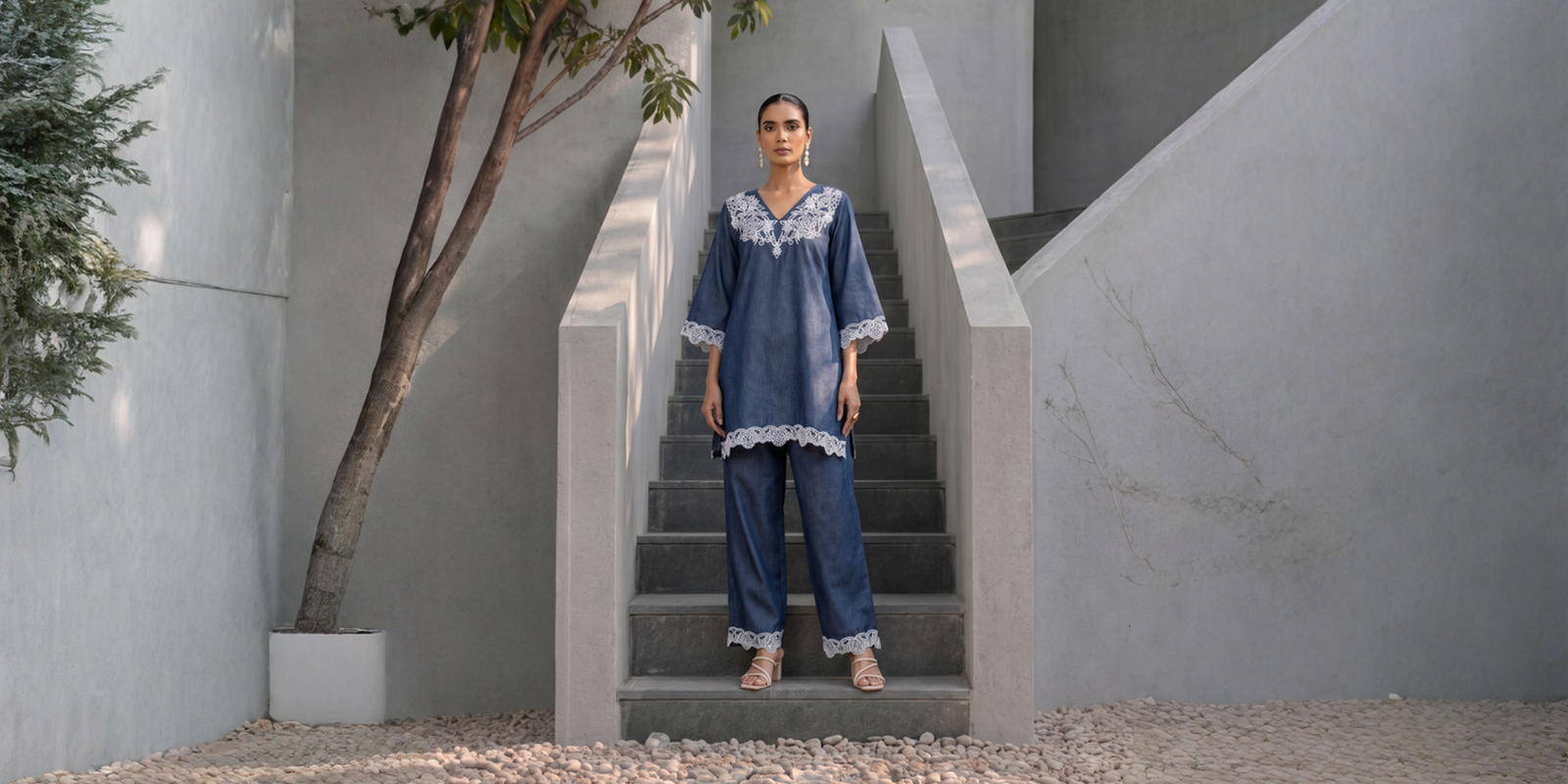
3. The Natural Crepe Embroidered Suit Set
Natural crepe is the answer to a question many women have: what do you wear to a summer wedding function when you need to look genuinely dressed up but cannot bear another hot afternoon in heavy fabric?
The fabric's crinkled surface texture is not just aesthetic. It creates actual air circulation. But the reason natural crepe works especially well for embroidered summer occasion wear is the drape. Embroidery applied to a stiff or structured fabric adds visual weight without adding softness. On natural crepe, the same embroidery sits within the movement of the cloth rather than on top of it.

The embroidery placement question is worth taking seriously. A natural crepe suit with embroidery at the neckline, down the placket, and at the hem reads complete and well-finished. Dense all-over embroidery on natural crepe defeats the purpose of choosing a breathable fabric because the embellished sections no longer breathe. Selective placement is both the more elegant and the more practical choice.
On fit for summer: Natural crepe suit sets should have some ease in the body. A fitted crepe suit looks good standing but becomes restrictive when you sit for a long period, and summer events often involve exactly that. A silhouette with a slight A-line or flared kurta, or at minimum a straight cut with side slits, allows better circulation and looks appropriate from multiple angles.
Colour considerations: Natural crepe in ivory, champagne, or pale gold has a soft luminosity that works beautifully in summer daylight. These tones also do not absorb heat the way deeper colours do. For women attending outdoor events, the colour choice is also a comfort choice.
Occasion mapping: Daytime wedding functions, engagement ceremonies, pre-wedding gatherings, festive lunches. The embroidered natural crepe suit occupies the useful middle ground between a casual linen set and a heavy festive lehenga or anarkali. It signals effort without signalling that you have spent three hours getting dressed.
4. The Viscose Silk or Chanderi Angrakha Set

The angrakha silhouette is having a genuine moment in Indian ethnic wear, and the reasons make sense beyond trend cycles. The wrap-front construction of an angrakha kurta creates a natural A-line from the waist, which is flattering across body types and allows the front of the garment to be adjusted slightly for comfort. The tie fastening at the side also means there is flexibility in fit that standard straight kurtas do not offer.
In viscose silk or chanderi fabric, the angrakha works particularly well in summer because the fabric movement amplifies the silhouette. When you walk, the front panels catch and fall. The garment looks like it is designed to move, because it is.
Body type considerations: Angrakha kurtas are generous to most body types because the wrap construction creates visual definition at the waist without requiring a fitted cut. For women who find straight kurtas boxy, the angrakha offers shape without structure. For women who prefer less definition at the waist, a longer angrakha that wraps lower creates a different line that works equally well.
The layering logic: One common mistake with angrakha sets in summer is wearing them with a heavy dupatta. The silhouette is already doing visual work at the front. A lightweight chanderi or mul dupatta draped loosely over one shoulder is enough. A heavy embroidered dupatta competes with the front panel construction and adds unnecessary warmth.
Occasion mapping: The angrakha format carries easily from a daytime event into an evening one. The same set that works for a haldi lunch works for an evening sangeet if you change from flats to heels and switch light silver jewellery to gold. Very few ethnic wear formats have that kind of range.
5. Pastel Colour Ethnic Wear in Lightweight Fabric

Pastel colour ethnic wear in summer is partly an aesthetic choice and partly physics. Lighter colours reflect radiant heat rather than absorbing it. The practical temperature difference between wearing pale mint and wearing deep navy on a sun-exposed afternoon is measurable. This is worth knowing before you reach for a darker tone because it looks richer on camera.
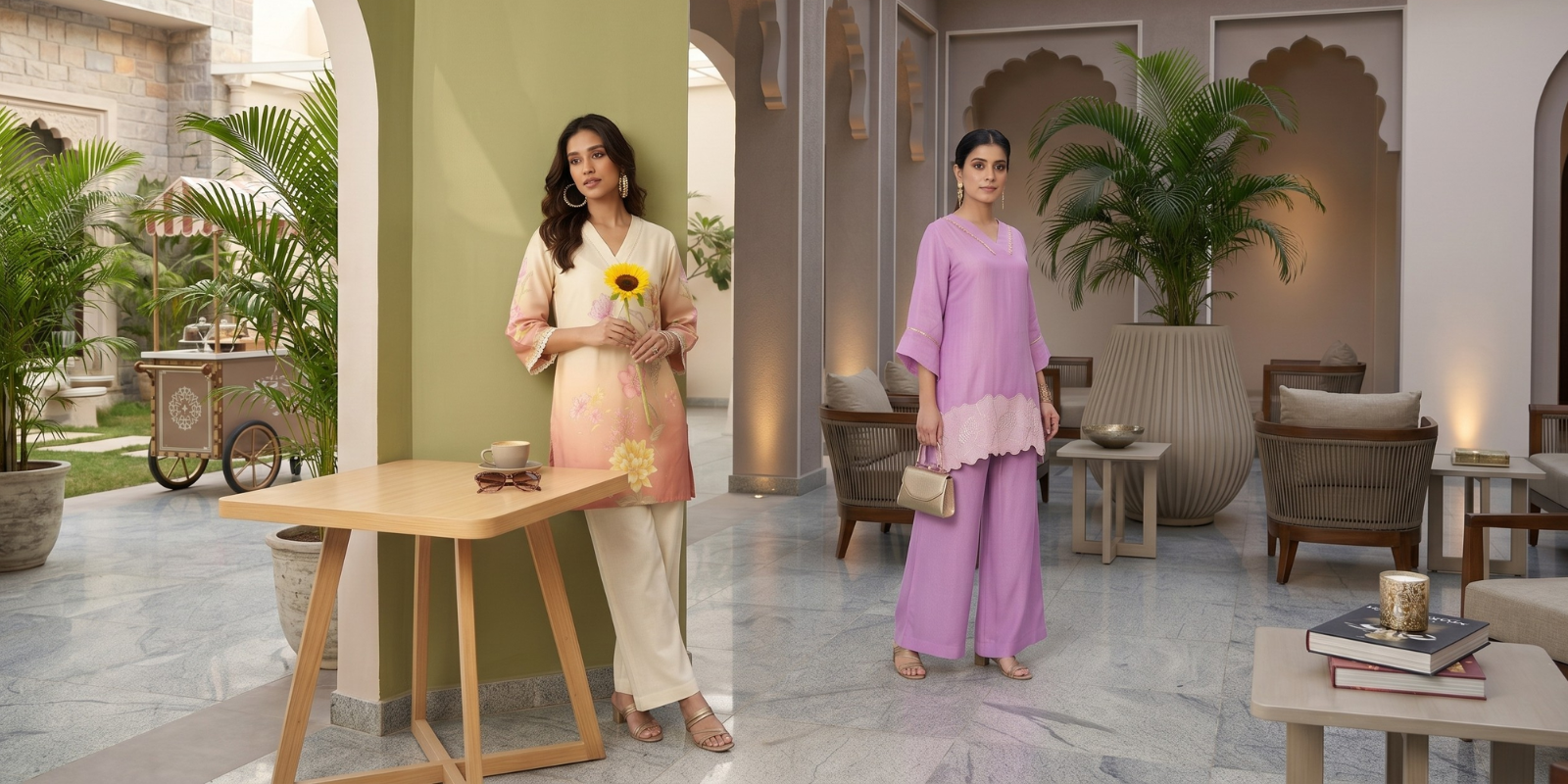
But the fashion argument for pastels in Indian ethnic wear is also genuine, and it goes beyond "pastels are summery." The specific tones that work best are the ones that have moved slightly away from the obvious pastels into more considered territory: warm ivory rather than stark white, dusty sage rather than mint green, grey-lavender rather than candy lilac, warm terracotta-peach rather than baby pink. These colours read sophisticated rather than sweet, and they travel across occasions without looking underdressed.
Pastels and skin tone: Warm-toned pastels, peach, cream, warm lilac, tend to work well across a wide range of Indian skin tones. Cool pastels, icy blue or very pale grey, can read washed-out against deeper skin tones unless the fabric has enough texture or sheen to compensate. Mul chanderi and natural crepe both have that compensating quality. A pale grey in flat cotton fabric looks different from the same tone in mul chanderi, where the slight sheen gives the colour depth.
Contrast and accessories: Pastel ethnic wear requires more attention to accessories than deeper tones do. A pastel kurta set with matching pastel jewellery disappears. The outfit needs contrast somewhere: in the jewellery tone, in the dupatta colour, or in the footwear. Oxidised silver against pale peach, deep emerald earrings against ivory, a contrast dupatta in a deeper tone of the same colour family. These pairings give the eye somewhere to rest.
Pastel co-ords specifically: Women who wear pastel co ord sets for summer find them easier to accessorise than pastel separates because the outfit already has internal coherence. The accessory job is simply to provide contrast, not to create coordination from scratch.
What Women Actually Get Wrong About Summer Ethnic Dressing
A few things worth saying plainly.
The biggest mistake is buying occasion wear in synthetic fabric because the print or embroidery looks right in the photograph. Photographs do not capture how fabric feels on a body at 38 degrees. Polyester georgette looks identical to natural georgette online. It does not feel identical in a summer afternoon.
The second mistake is treating summer ethnic wear as a purely festive category. Women's summer outfit ideas that cover everyday ethnic dressing, casual kurta sets for weekends, linen co-ords for outings, simple Chanderi sets for a relaxed temple visit, are underserved by most brand conversations about summer wear. Not everything needs to be occasion-specific.
Third: care labels matter, and ignoring them is expensive. Natural fabrics like linen, mul chanderi, and natural crepe are not forgiving of machine washing or tumble drying. The fabric might survive the first cycle but the hand feel and structure will have shifted. If you are investing in well-made ethnic wear in natural fabrics, the five minutes of hand washing is worth protecting that investment.
On mixing prints in summer ethnic wear: A printed linen kurta with printed palazzo pants is a risk. Both pieces need to be in the same colour family and the print scales need to be different enough to read as deliberate rather than accidental. A small floral kurta with a wider geometric pant in the same palette works. Two competing florals do not, regardless of how much the prints appeal individually.
Brands Worth Knowing
The honest conversation about summer ethnic wear includes who is making it well at prices that are not exclusively for special occasions.
Vannya B, a Hyderabad-based label with a dedicated Summer Soiree collection, is one of the better options currently available for mul chanderi and linen ethnic wear in this price range. The pieces are designed for actual occasions rather than for editorials, which shows in the fit and the length choices. The embroidery on their suit sets is placed selectively rather than spread across the entire garment, which is the right instinct for summer fabrics. Their linen printed sets sit in the Rs. 2,400 range and the mul chanderi pieces between Rs. 3,000 and Rs. 3,800, which is honest pricing for the craft involved.
Other labels worth exploring in the same space include regional craft-forward brands that work directly with weavers, particularly for chanderi and linen. Prices tend to be more transparent and the fabric quality more consistent when the supply chain is shorter.
The Question of Occasion Versus Every Day in Summer
Summer in India spans roughly five months depending on where you live. The assumption that ethnic wear is primarily for occasions becomes a limiting belief over that stretch of time. A well-chosen linen kurta set or a cotton mul chanderi co-ord works for a regular Saturday as well as it works for a function. The difference is in how you accessorise it.
The women who have figured out ethnic summer wear treat it the same way they treat any well-made wardrobe category: a small number of pieces in good fabrics, chosen for versatility across occasions, cared for properly so they last multiple seasons.
Five pieces, worn right and looked after, will take you through a full Indian summer without the recurring frustration of getting dressed for an event and arriving already uncomfortable.
Whether any of that is worth the care label compliance and the hand washing is a decision only you can make. But the fabric options above make the case that comfort and dressing well for summer occasions are not a trade-off. They are the same choice.
Popular Questions Regarding Summer Ethnic Wear Answered
Q: What is the best fabric for ethnic wear in Indian summer?
Linen, mul chanderi, and natural crepe are the three that consistently deliver. Of these, linen is the most forgiving in daily use because it handles both dry heat and moderate humidity well. Mul chanderi is the better choice for occasions where you want a slightly more dressed-up look. Natural crepe is for events where you need the outfit to read elevated without weighing you down. The one fabric worth actively avoiding is embellished synthetic georgette. It looks festive in photographs and is genuinely uncomfortable to wear once temperatures cross 35 degrees.
Q: Is Mul Chanderi good for summer or is it too sheer?
It is good for summer precisely because of how it is woven. The open structure of the mul weave allows air to circulate through the cloth. Yes, it has some sheerness, especially in lighter colours, and a slip underneath or a lined hem deals with that completely. The sheerness is not a flaw. It is what makes the fabric breathable. A lined mul chanderi kurta is warmer than an unlined one, so keep the lining minimal if breathability is the priority.
Q: Can I wear a co-ord set to a wedding function or is it too casual?
Depends entirely on the fabric and styling. A cotton co-ord set is casual. A linen or mul chanderi co-ord set styled with the right jewellery and a dupatta sits comfortably at daytime wedding functions, sangeet lunches, mehendi ceremonies, and haldi events. The format reads modern rather than ceremonial, which works well for pre-wedding occasions. For the main wedding ceremony or an evening reception, most women shift to a suit set or something with more embellishment. But the assumption that co-ord sets are inherently informal is outdated.
Q: What colours work best for summer ethnic wear for Indian skin tones?
Warm pastels travel well across most Indian skin tones: dusty peach, warm ivory, sage green, and muted terracotta-adjacent tones tend to flatter more broadly than cool pastels like icy blue or mint. Deep skin tones look particularly striking in ivory, warm gold, and burnt orange, which are technically summer colours even if people associate them with autumn. Very pale or washed-out pastels, like baby pink or powdery lilac in flat fabrics, can read absent against deeper skin tones. The fabric matters here as much as the colour. The same pale grey in mul chanderi, which has a sheen, looks different than pale grey in cotton, which does not.
Q: How do I style a salwar suit set for a daytime summer wedding?
Keep the accessories lighter than you think you need to. A summer daytime wedding is not the occasion for heavy necklaces and layered bangles. One statement earring, a single-strand necklace or none at all, and a pair of juttis or block heels takes a well-chosen suit set far. The dupatta is doing most of the dressing-up work. A contrast dupatta in a deeper tone of the suit's colour family, or a printed dupatta against a solid suit, gives the outfit enough visual interest without adding the physical weight of heavy jewellery.
Q: What is the difference between natural crepe and synthetic crepe, and why does it matter in summer?
Natural crepe is made from silk or blended with natural fibres. Its crinkled surface creates tiny air pockets between the cloth and your skin, which actually does something useful in heat. Synthetic crepe is polyester that has been textured to look similar. It traps moisture against the body, does not allow air through, and gets noticeably uncomfortable in warm weather. Online listings often just say "crepe" without specifying. If the product description does not mention silk, wool, or natural fibre content, assume it is synthetic and factor that into the decision.
Q: Can I wear linen ethnic wear to a festive occasion or does it look too casual?
Pure linen in a plain weave, yes, it can skew casual. But printed linen kurta sets and linen suit sets in festive cuts read very differently. A linen set with a floral or block print, a dupatta, and considered accessories sits well at haldi ceremonies, afternoon receptions, casual Diwali gatherings, and family pujas. What linen does not handle well is very formal evening occasions where the expectation is richer fabric. The transition from linen to something more festive happens at the point where the event moves indoors, into evening light, and requires embroidery or surface work.
Q: What should I wear to a summer wedding if I want to look dressed up but stay comfortable?
A natural crepe embroidered suit set is probably the closest answer to both requirements simultaneously. The fabric breathes, the drape is soft, and selective embroidery at the neckline and hem reads festive without adding the weight of all-over embellishment. An angrakha-style kurta in viscose silk or mul chanderi is another option that photographs well and feels good to wear for extended periods. The mistake most women make is choosing the outfit by how it looks on a hanger or in a photograph rather than how it performs on a body over five or six hours in mixed indoor-outdoor conditions.
Q: How do I keep ethnic wear looking fresh through a long summer event?
Fabric choice handles most of this automatically if you get it right. Beyond that: carry a small safety pin for the dupatta so it stays in place without constant adjustment, wear undergarments in a sweat-wicking fabric under the kurta rather than cotton, and if you are outdoors for any extended period in direct sun, a light dupatta draped over the shoulders does double duty as sun protection and keeps the outfit looking complete. Avoid eating in heavy fabrics or light-coloured outfits at seated meals, which sounds obvious until it is your ivory linen kurta at a buffet lunch.
Q: Is viscose silk a good fabric for summer or should I avoid it?
It is fine in dry heat and air-conditioned environments. In coastal or humid conditions, viscose silk starts to feel heavier once it warms up because the fibre absorbs moisture and holds it longer than natural silk would. If you are in a city with a dry summer, like Delhi or Hyderabad in April, viscose silk is a genuinely good-looking fabric that works for occasions. If you are in Mumbai or Chennai in June, linen or mul chanderi will serve you better.
Q: How many pieces of summer ethnic wear do I actually need?
Less than most people think. Three to four well-chosen pieces in good fabrics cover most of what Indian summer social life requires. A linen or mul chanderi co-ord set for casual functions and daytime events, a salwar suit in mul chanderi for mid-range occasions, an embroidered natural crepe suit for weddings and formal events, and an angrakha or printed kurta set for the rest. The trap is buying many mediocre pieces in average fabrics that are each right for one occasion. Four pieces in good natural fabrics, styled differently with accessories and dupatta choices, stretch further and feel better than ten pieces in synthetic blends.
Q: What jewellery works with pastel ethnic wear in summer?
Oxidised silver is the answer most of the time. It has enough visual weight to anchor a pale outfit without the heaviness of gold. Terracotta or wooden jewellery in earthy tones works particularly well with linen pieces in neutral or muted palettes. The mistake is going too delicate: very fine gold chains or tiny stud earrings disappear against pastel fabric and the outfit ends up looking undone rather than understated. One piece of real presence, a pair of jhumkas, a statement ear cuff, or a single arm cuff, does more for the overall look than several small pieces that collectively read as nothing.