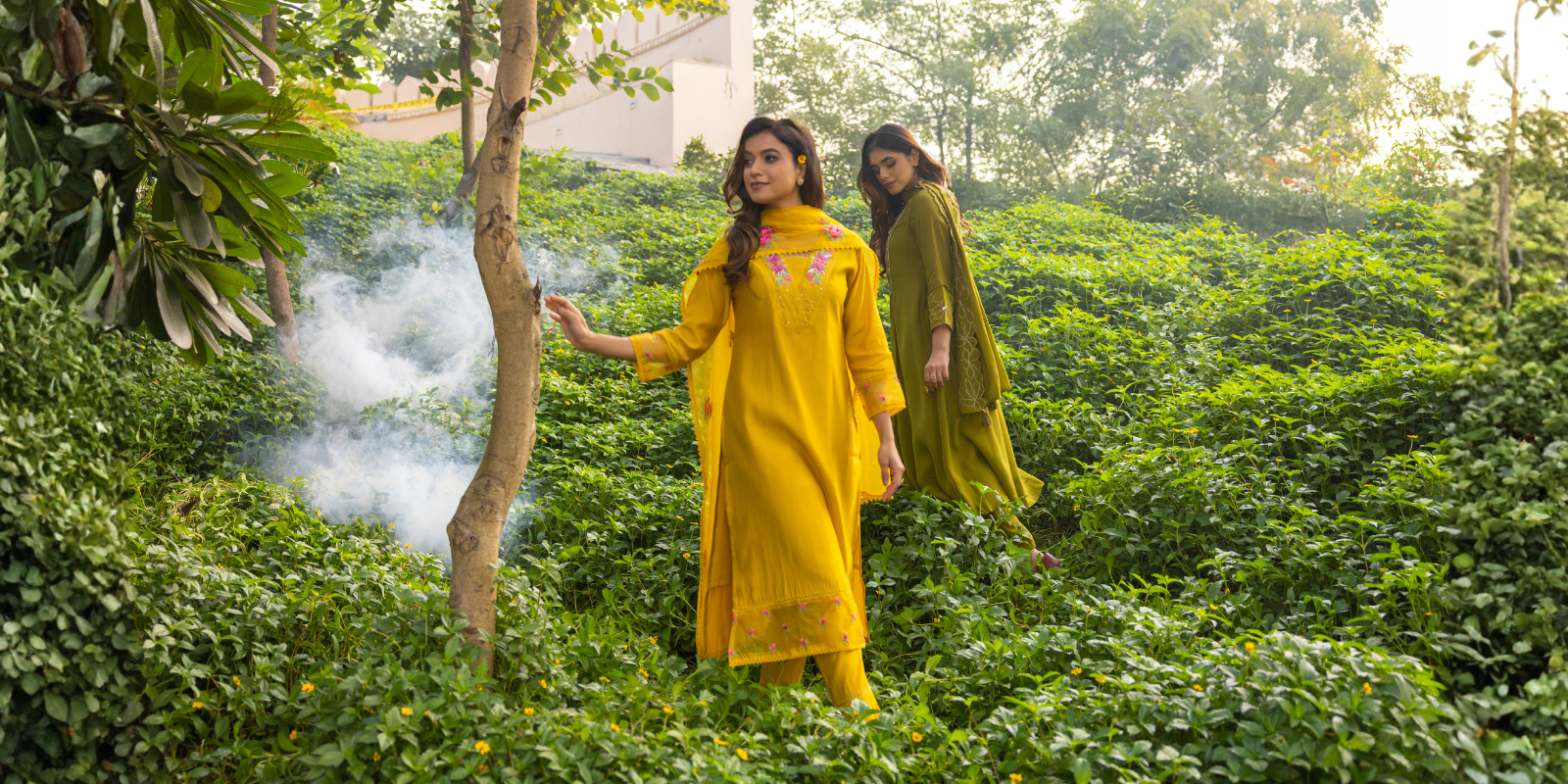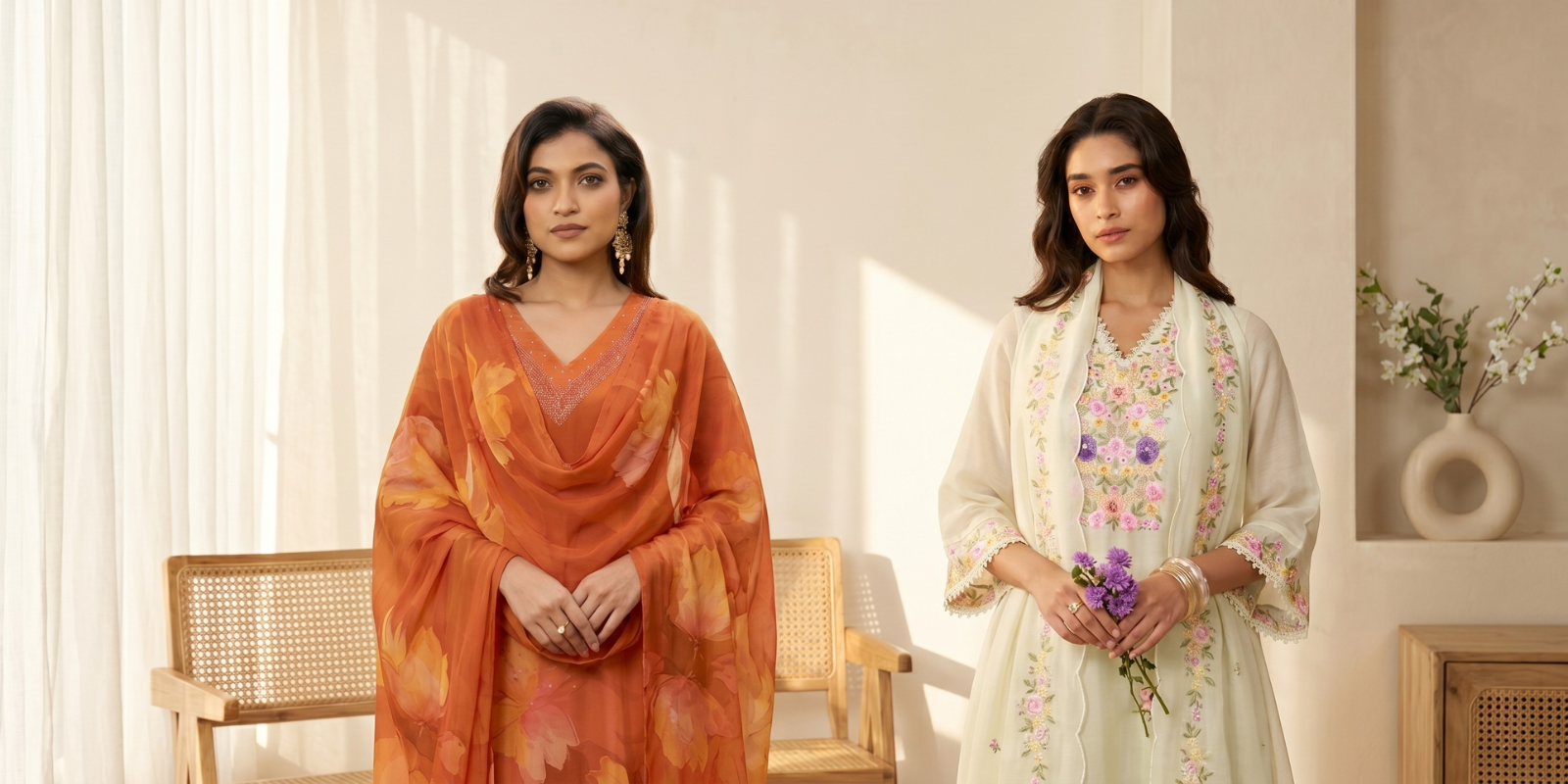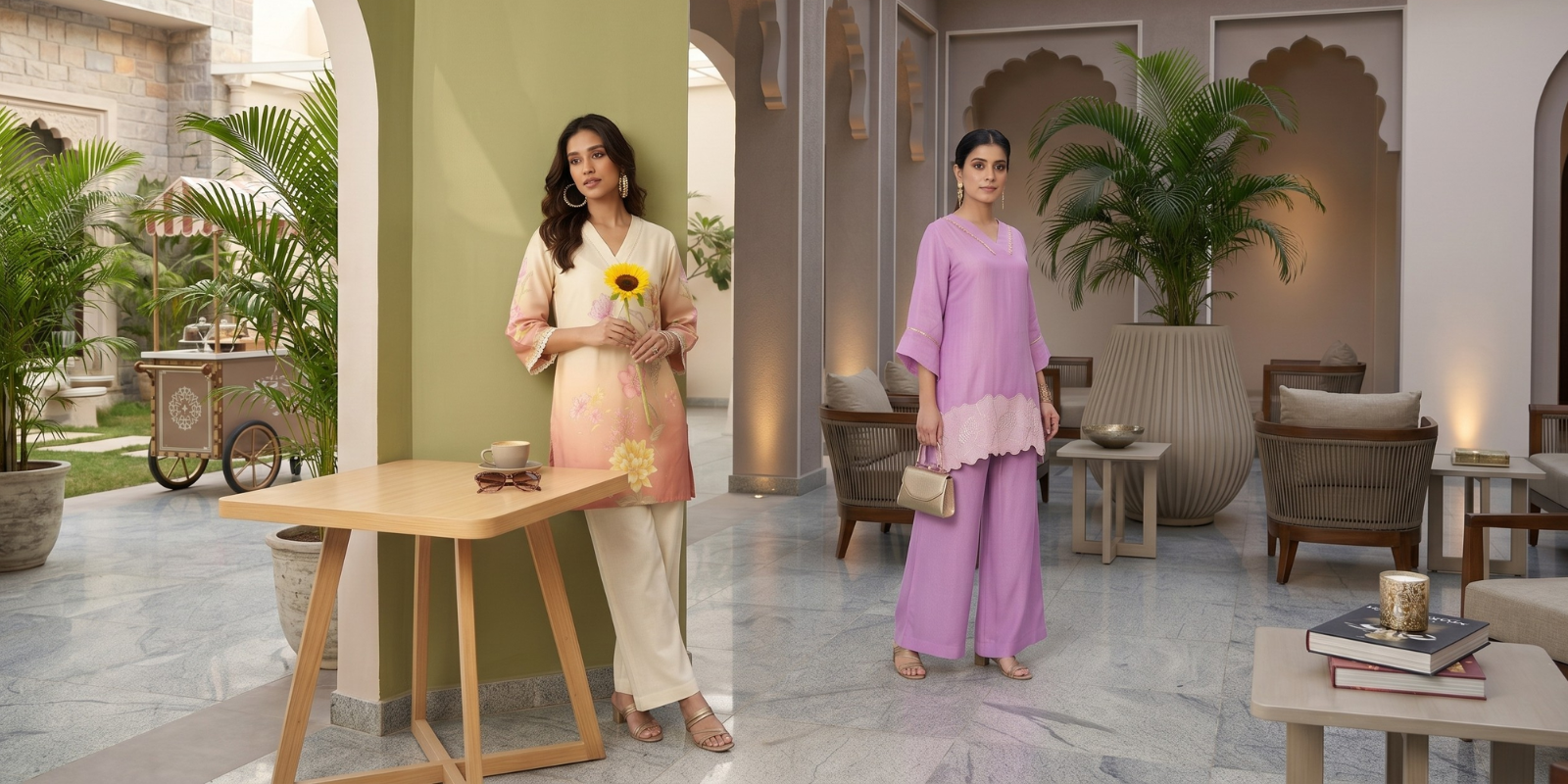
One Outfit, Three Ways: How to Style Co-ord Sets for Any Occasion
There is something quietly satisfying about opening your wardrobe, pulling out two pieces, and knowing before you even hold them up that the outfit is done. Co-ord sets have that effect. The top and bottom are already decided. The colour story is written. You just have to show up.
But women keep asking the same question: is it too matchy? Too obvious? Too much like a night suit?
Here is the honest answer. Yes, there are co-ord sets out there that look like nightwear. They exist. And women who get dressed in them and then wonder why nobody takes the look seriously are usually wearing exactly those. The issue is almost never the silhouette. It is the fabric. It is the cut. It is the styling choices around the outfit that either elevate it or flatten it completely.
Choose the right co-ord and you can wear it to a mehendi lunch, a birthday dinner, and a cousin's wedding sangeet. The occasion changes. The outfit, largely, stays the same. That is the whole point.
How to Style Co-ord Sets: The Fabric Conversation Nobody Has
Before accessories. Before footwear. Before you even think about which bag goes with what. Fabric is the first decision, and it is the one that determines how the rest of the outfit lands.
Natural crepe is where a lot of Indian ethnic co-ord sets live right now, and for good reason. It has enough weight to drape beautifully, resists wrinkling through a long event, and photographs in a way that almost every other fabric does not. You have probably seen a printed crepe co-ord look completely different at 11am and 7pm. The colour reads richer in lower light. The fabric catches the warmth. It is not magic, it is just crepe doing what crepe does.
Linen co-ord sets are a different conversation altogether. The breathability is real. Indian summers are 40 degrees and humid, and standing in a fitted, lined garment for four hours at an outdoor function is its own kind of suffering. Linen does not do that to you. It sits lightly. It rumples slightly, which, in a casual co-ord context, actually reads as intentional rather than careless. Linen suits the afternoon mehendi, the open-air market, the baithak at a friend's place where the dress code is "ethnic but comfortable."
Shimmer fabrics are having a cultural moment right now and they deserve their own paragraph. Shimmer in ethnic co-ord sets tends to intimidate women who worry they will look overdressed. The rule is simpler than people assume: if the shimmer is in the weave rather than applied as a coating, it behaves. It catches light without screaming. A shimmer co-ord in a deep jewel tone, styled with flat kolhapuris and a thin gold chain, reads as effortlessly festive. The same set with heavy jhumkas and a box clutch becomes full evening wear. That range, from low-key festive to dinner-ready, is what makes shimmer co-ords genuinely worth investing in.
Roman chanderi is worth mentioning separately because it occupies an interesting space. Lighter than regular chanderi, slightly more structured than crepe, it holds embroidery well and has a surface that catches light without being overtly shimmery. Three-piece sets in this fabric, with a dupatta that matches the border rather than the base, tend to read as traditionally grounded but completely contemporary in silhouette.
How to Style Co-ord Sets: The Three-Occasion Rule
Most women buy a co-ord set for one occasion. Then it sits in the wardrobe because they cannot figure out where else it belongs. The better approach is to choose a set that already carries some occasion flexibility, and then style around it three ways.
Occasion One: Casual Ethnic Wear for Women
Casual ethnic wear for women is possibly the most under-styled category in Indian fashion. Women tend to either go fully festive or reach for western casuals when they want to dress down. The middle ground, a well-chosen ethnic co-ord that feels relaxed without looking like you stopped trying, is often left unexplored.

A printed crepe co-ord with a kurta-style top and straight palazzo works here. Keep the dupatta off. Throw it over one shoulder if the occasion needs it, leave it in your bag if it does not. Kolhapuri sandals or juttis in a contrasting colour pull the look into casual territory without making it look unfinished. Minimal jewellery. One pair of small earrings. No more.
The mistake most women make with casual co-ord styling is accessorising the same way they would for a function. Heavy earrings and a dupatta transform a relaxed co-ord into something more formal. Remove one or both and the entire register of the outfit shifts.
A linen co-ord set here is genuinely ideal. The slight textural irregularity in slub linen, the natural drape that softens with wear, the way it moves when you walk, these are all things that read as easy and considered rather than effortful. For summer co-ord set women, linen is the obvious choice, and it is also the one that is most often overlooked because women associate it with western styling rather than ethnic.
Occasion Two: Festive Co-ord Set for Women
Festive dressing in India has its own grammar. There is a minimum level of richness expected. Bare fabrics without texture or detailing tend to read as underdressed no matter how intentionally chosen they are.

This is where a shimmer co-ord set earns its place. A dual-tone crepe co-ord, where the top and bottom are in different but coordinated shades rather than an exact match, adds visual interest without the chaos of contrasting prints. The colour story is considered. It reads like a choice. Women who want to experiment with co-ord sets for festive occasions but worry about looking too casual often find that dual-tone sets resolve that problem neatly.
For Diwali, a sangeet, or a puja evening at a relative's, the styling around a festive co-ord set should carry the weight. Go heavier on the jewellery than you would for casual wear. A pair of chandbaali earrings with a simple chain, or oxidised silver with a warm-toned fabric, both work. Bring in the dupatta. How you drape it changes the personality of the outfit considerably. A dupatta worn across the chest and pinned at the shoulder reads as dressy. The same dupatta loosely folded over one arm reads as relaxed festive. The co-ord is the same. The occasion feels different.
Block-heeled kolhapuris or kitten-heeled sandals in a metallic finish both work here. Wedges if you are going to be standing for long periods. Flat mojris if the event is more intimate and the venue is uneven ground, which is more than half of Indian festive events.
Occasion Three: Wedding Co-ord Set for Women
Wedding functions are the real test for a co-ord set. Women investing in a wedding co-ord set for women are essentially asking the outfit to pass scrutiny from relatives, photographers, and other guests who are wearing everything from casual salwar to full bridal lehenga. The co-ord needs to hold its ground.
Three-piece sets, meaning top, bottom, and dupatta in complementary fabric and palette, give the most control here. The dupatta allows for adjustments. If the mehendi is outdoors in the afternoon, the dupatta goes loosely over the shoulder. If it is an evening sangeet, the dupatta is draped more formally and the jewellery comes up. The same three-piece set navigates both.
Roman chanderi with embroidery does the heavy lifting on wedding occasions. The fabric is festive enough to belong without competing with the lehenga-wearing guests. An embroidered kurta-style top with a straight-cut palazzo or wide-leg bottom is the silhouette that tends to work across body types. The vertical lines in a straight palazzo are flattering. They also make the outfit feel more deliberate than a flared or gathered bottom, which can overwhelm a two-piece set.
Jewellery for a wedding co-ord should go heavier than you would normally choose. This is the occasion where a polki set or a layered gold choker with matching jhumkas is appropriate. The co-ord itself stays clean. The jewellery does the festive work.
What to Wear with a Co-ord Set: The Styling Questions Women Actually Ask
Can you pair a co-ord set with a different dupatta?
Yes. And it often looks better than the original combination. A dupatta in a contrast colour, or in the same colour but a different texture, adds intentionality to the outfit. If your co-ord is in a solid tone, a dupatta with border embroidery in a contrasting shade elevates the whole look into occasion wear. If your co-ord is printed, a solid dupatta in one of the accent colours from the print brings cohesion.
Do co-ords work for women who are petite?
The silhouette matters more than the print here. Petite women tend to do better with a shorter kurta-style top that ends at or above the hip, paired with a full-length palazzo or straight pant. This creates a visible waist point and allows the legs to appear longer. Avoid co-ords where the top is long and boxy, those tend to read as one long piece rather than two coordinated pieces.
Can you separate the pieces and wear them with other outfits?
This is the genuinely underused value of a good co-ord set. A crepe kurta-top from a co-ord set worn with a contrasting palazzo from a different set, or paired with cigarette pants in a complementary neutral, extends the wardrobe considerably. If you are buying a co-ord set primarily for one occasion, think about whether either piece could rotate into other combinations. If the answer is yes, the cost-per-wear drops significantly.
What footwear works best?
For casual co-ord occasions: juttis, kolhapuris, flat sandals in contrast colour. For festive occasions: block heels, kitten heels in metallic finish, wedges for outdoor venues. For weddings: embroidered mojris, block-heeled sandals in gold or silver, kitten heels with anklet detail.
Avoid very high stilettos with kurta-style co-ords unless the bottom is a cigarette trouser. The proportions stop working.
Summer Co-ord Sets for Women: The Heat Has an Answer
Summers in the Deccan, in coastal cities, in North Indian plains, they all have the same problem. You want to look dressed. You want to feel like you chose your clothes. And you do not want to be miserable by noon.

The summer co-ord set for women that actually works tends to share a few qualities. Natural fibre or natural crepe in the base fabric. A silhouette that allows airflow, meaning wide-leg palazzos over fitted churidars, loose kurta tops over boxy blouses. A palette that is not trying to absorb heat, so pastels, ivories, soft earth tones, mint, and sage rather than deep navy or black.
Printed crepe in summer works well because the print itself adds visual interest without relying on embroidery or embellishment, both of which add weight. A digital-print crepe co-ord in a floral or geometric pattern stays cool, prints well in photographs, and does not require the care that hand-embroidered fabrics need.
The dupatta in summer is a personal choice. In very humid climates, it becomes a practical burden. In those cases, a co-ord set styled without the dupatta, with a statement neckpiece instead, is a completely legitimate approach. The neckpiece does the decorative work the dupatta would normally do. The outfit stays breathable.
Co-ord Set Styling Done Right: A Quiet Word About Vannya B
Vannya B is a Hyderabad-based ethnic wear brand with a co-ord set collection that sits in an interesting middle ground between everyday festive and occasion wear. The Nandini Natural Crepe Printed Co-ord Set is a good example of what they do well. Crepe, printed, and designed with the kind of colour restraint that makes the set easy to style without overthinking. The Amrita Natural Crepe Dual-Tone Co-ord Set does something slightly different, using two coordinated tones rather than a single print, which gives the outfit more occasion flexibility.
The three-piece Chandrika Roman Chanderi set is worth noting for wedding functions specifically. Roman chanderi in a three-piece format, with the structured drape a chanderi dupatta offers, carries enough visual weight for a mehendi or a haldi without trying too hard.
The shimmer and linen co-ord set categories on the site cover opposite ends of the fabric spectrum, which means the co-ord styling conversation can go from breathable summer dressing to festive evening wear within the same brand. That kind of range is practical for women who prefer to build a wardrobe rather than buy for single occasions.
The pricing sits in a range that makes re-wearing realistic. Which is, honestly, the only kind of festive wardrobe worth building.
Co-ord Set Styling and the Night Suit Conversation
Let us address it directly. The reason co-ord sets get compared to night suits is that certain co-ords, particularly in lightweight cotton with loose, boxy cuts and no structure, do look like very nice pyjamas. This is a fabric and silhouette problem, not an inherent problem with the co-ord format.
The separation between sleepwear and occasion wear in a co-ord set comes from three places. First, fabric weight and drape. Crepe, chanderi, and shimmer fabrics do not read as lounge wear. They carry. They have presence. Second, structure. A top with tailoring at the waist, a neckline with embroidery, a palazzo with a clean hem rather than elastic gathering, these signals separate a co-ord from pyjamas. Third, styling. The right footwear and jewellery do more work than people realise. Wear a boxy cotton co-ord with sliders and your hair down, and yes, it reads as casual enough to be home wear. Wear the same piece with pointed juttis, a structured bun, and gold earrings, and it reads as completely intentional ethnic casual.
The outfit has not changed. The context has.
Frequently Asked Questions
What occasions can I wear a co-ord set to?
Co-ord sets for women work across a wide range of occasions. Casual ethnic co-ords in crepe or linen are suited to family lunches, puja mornings, and relaxed outings. Festive co-ord sets in shimmer or embroidered chanderi work for Diwali evenings, sangeets, and small family celebrations. Three-piece co-ord sets in roman chanderi or dual-tone crepe are appropriate for pre-wedding functions, mehendis, and haldi ceremonies. The fabric and styling choices determine which occasion the set belongs to.
How do I style a co-ord set to look festive without being overdressed?
The balance comes from jewellery and the dupatta. Keep the jewellery restrained if the fabric is rich, heavier if the fabric is plain. Bring the dupatta in for formal occasions and leave it draped loosely for semi-formal ones. A shimmer co-ord in a muted tone, styled with simple gold jhumkas and pointed juttis, sits in the festive-but-not-heavy territory most women are looking for.
Can co-ord sets be worn to weddings?
Yes, particularly for daytime or pre-wedding functions. A three-piece co-ord set in roman chanderi, chanderi, or embroidered crepe works well for haldi, mehendi, and sangeet. For the main reception or wedding ceremony, a more elaborate three-piece set with heavier embroidery and a well-draped dupatta is appropriate. The co-ord set holds its own as long as the fabric and styling carry enough occasion weight.
What is the best fabric for a summer co-ord set?
Natural crepe and linen are the most practical choices for Indian summers. Crepe drapes well, resists wrinkling through long events, and maintains colour depth in heat. Linen breathes better than almost any other fabric and is ideal for outdoor summer occasions. Both fabrics photograph well in natural light.
How do I choose between a two-piece and a three-piece co-ord set?
For casual and semi-formal occasions, a two-piece co-ord with the dupatta as an optional addition gives more flexibility. For festive and wedding occasions, a three-piece set with a dedicated dupatta is more appropriate. The dupatta in a three-piece set also gives you styling options that change the formality of the outfit without changing the core pieces.
Can I separate the pieces of a co-ord set and wear them with other outfits?
In most cases, yes. A printed kurta-style top from a crepe co-ord set pairs well with neutral palazzos, cigarette trousers, or even a contrasting palazzo in a complementary colour. The bottom from a co-ord set can work with plain or lightly embroidered tops in the same colour family. The co-ord styling investment extends beyond the set itself.
What shoes go best with ethnic co-ord sets?
For casual co-ords: kolhapuris, juttis, or flat sandals in a contrast colour. For festive occasions: block heels, kitten heels, or wedges in a metallic finish. For weddings: embroidered mojris or block-heeled sandals in gold or silver. Pointed-toe flats in leather or fabric elevate a casual co-ord significantly without adding height.
What Separates a Good Co-ord Set from One You Wear Once
A co-ord set you wear once is usually one where the styling possibilities stop at the obvious. The print is too specific to the occasion. The top is too boxy to work with anything else. The colour is too deep or too pale to pair differently. You wore it to the occasion, it looked appropriate, and now it lives in the back of the wardrobe.
A co-ord set worth the investment is one where the fabric drapes, the colour has range, and the top can be worn with different bottoms. Where the dupatta is generous enough to drape multiple ways. Where the print, if there is one, is considered enough to read differently depending on the accessories around it.
That is the actual question to ask before buying a co-ord set. Three ways. Can you name three ways to wear this? If the answer comes easily, the set is worth it. If the answer requires too much imagination, you are probably looking at a single-occasion outfit. Those exist too, and they have their place. But the co-ord sets that earn genuine wardrobe space are the ones that keep finding reasons to come back out.